OpenEMR gives healthcare organizations considerable flexibility. It is open source, provides access to its source code, supports extensive customization, and includes a broad range of clinical and practice management functionality.
But as we explored in our previous articles, this flexibility also comes with responsibility. Depending on how OpenEMR is deployed, healthcare organizations may need to manage hosting, security, updates, backups, customization, integrations, and ongoing technical maintenance.
For organizations with experienced IT teams, this level of control can be an advantage. For clinics that would rather focus their resources on patient care and everyday operations, it may be a reason to explore OpenEMR alternatives.
And finding the right alternative does not necessarily mean replacing one open source EMR with another.
List of the Content
- Why look for an OpenEMR alternative?
- What should you look for in an OpenEMR alternative?
- Another open source EMR or a managed platform?
- LinkHMS as an OpenEMR alternative
- Why LinkHMS can be a better fit
- Choosing the right OpenEMR alternative
- OpenEMR alternatives: conclusion
Why look for an OpenEMR alternative?
There are many reasons why a healthcare organization might consider an alternative to OpenEMR.
Some clinics may want to reduce the technical resources required to operate their EMR. Others may be looking for simpler implementation, ongoing vendor support, or functionality that extends beyond electronic medical records into wider clinic and hospital operations.
Although OpenEMR does not require conventional software licensing fees, operating a self-hosted system can involve expenses for infrastructure, implementation, maintenance, customization, security, technical support, and staff training.
As a result, the decision is not simply about whether OpenEMR has the necessary features. It is also about whether its operating model matches the resources and priorities of your healthcare organization.
What should you look for in an OpenEMR alternative?
Before choosing another system, start with the reasons you are considering a change.
If your organization still wants source-code access and complete control over its infrastructure, another open source EMR may be the logical choice.
But if hosting, maintenance, technical complexity, or fragmented healthcare operations are driving the search, replacing OpenEMR with another self-hosted platform may not solve the underlying problem.
In this case, consider several areas when evaluating OpenEMR alternatives.
Managed infrastructure
Who is responsible for running the technology behind the EMR?
With a managed cloud platform, healthcare organizations do not need to independently maintain the servers and underlying software environment required to operate the system. This can significantly reduce the technical workload for clinics without dedicated IT teams.
Security and ongoing maintenance
EMR security is not a one-time configuration. Software updates, backups, access management, monitoring, and other security measures need ongoing attention.
When considering an OpenEMR alternative, look at how these responsibilities are divided between the healthcare organization and the software provider.
Clinical and administrative functionality
An EMR is only one part of running a healthcare organization.
Patient registration, appointments, admissions, billing, insurance, laboratory work, pharmacy operations, inventory, and financial management all generate information that needs to remain connected to patient care.
A system that supports these processes together can reduce the need to manage multiple disconnected applications.
Implementation and support
Consider what happens after you choose the software.
Who helps configure it? How much technical work is required before your team can start using it? Who handles problems after implementation? How are updates delivered?
These questions can be just as important as the initial feature list.
Reporting and business visibility
Healthcare organizations increasingly need more than access to individual patient records. They also need to understand what is happening across their operations.
An OpenEMR alternative can provide additional value when clinical, operational, and financial data can be used to monitor workflows, track revenue and payments, identify trends, and support management decisions.
Another open source EMR or a managed platform?
This is one of the most important decisions to make when looking at alternatives to OpenEMR.
Choosing another open source EMR can provide many of the same advantages as OpenEMR, including source-code access, customization, and greater control over deployment.
However, it can also preserve many of the same responsibilities.
Your organization may still need to arrange hosting, configure the environment, manage updates, maintain customizations, monitor security, and provide or purchase technical support.
A managed EMR takes a different approach.
Instead of giving the healthcare organization software to operate independently, the provider manages the platform and much of the technical environment behind it. The clinic can then concentrate on configuring and using the system around its actual workflows.
For organizations exploring OpenEMR alternatives because of technical overhead, this difference can be more important than simply choosing another EMR product.
LinkHMS as an OpenEMR alternative
LinkHMS provides a managed alternative for clinics and hospitals that want comprehensive healthcare management functionality without maintaining a self-hosted EMR environment.
Electronic medical records are part of a wider platform connecting different stages of the patient journey and everyday healthcare operations.
Healthcare teams can use LinkHMS to manage patient records, appointments, admissions, clinical workflows, billing, insurance claims, laboratory processes, pharmacy operations, inventory, medication management, and reporting.
This broader approach is particularly useful when a healthcare organization wants to move beyond simply digitizing medical records.
Patient activity can remain connected with the administrative and financial processes surrounding care, giving different teams access to the information they need within the same system.
Why LinkHMS can be a better fit
For clinics considering an OpenEMR alternative, LinkHMS changes more than the software itself. It changes how technology is managed.
Less technology to manage internally
Clinics do not need to build and maintain their own EMR infrastructure. LinkHMS is provided as a managed platform, reducing the technical responsibilities associated with operating a self-hosted system.
Connected healthcare operations
LinkHMS brings patient records together with the workflows surrounding them.
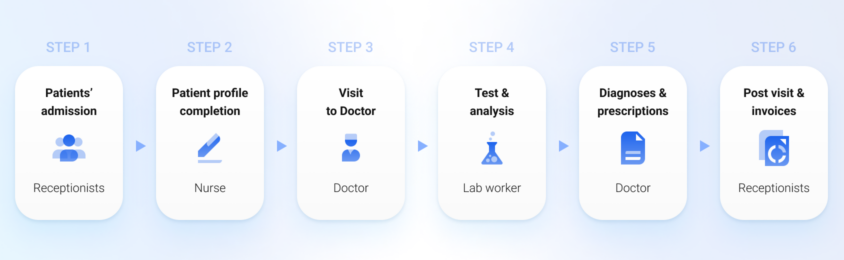
A patient’s journey can include registration, appointments, consultations, laboratory tests, prescriptions, pharmacy dispensing, admission, treatment, billing, and insurance. Keeping these processes connected makes it easier to manage both patient care and the organization behind it.
Financial and operational reporting
LinkHMS also turns everyday clinic activity into useful insights for administrators.
Operational and financial reporting helps healthcare organizations monitor workflows, revenue, collections, and overall performance without relying only on information from individual patient records.
Support beyond implementation
A managed system also provides a clearer support model. Instead of coordinating different parties responsible for hosting, software, customizations, and infrastructure, healthcare organizations work with the platform provider for the service they use.
This can be particularly valuable for growing clinics that need reliable healthcare technology but do not want to build an internal software and infrastructure team around their EMR.
Choosing the right OpenEMR alternative
The right choice ultimately depends on what your organization expects from its healthcare software.
If access to source code, complete infrastructure control, and extensive code-level customization are essential, OpenEMR or another open source EMR may remain the better approach.
But many clinics do not need that degree of technical control.
They need patient records to be accessible. They need appointments and admissions to stay organized. They need laboratory and pharmacy teams to work with current information. They need billing and insurance processes connected with care. And they need visibility into how the organization is performing.
If these are the priorities driving your search for OpenEMR alternatives, a managed healthcare platform can be a more practical choice.
OpenEMR alternatives: conclusion
Looking for an OpenEMR alternative does not have to mean finding another system that works exactly like OpenEMR.
It can also be an opportunity to reconsider what your healthcare organization actually needs from its technology.
The best OpenEMR alternative may therefore not be another open source EMR. It may be a platform that allows your healthcare team to spend less time managing software and more time using it to run the organization.
Rather than requiring clinics to manage the technology behind their EMR, LinkHMS provides a managed environment that connects patient records with the wider operations needed to deliver and manage care.